Associate Prof, University College London
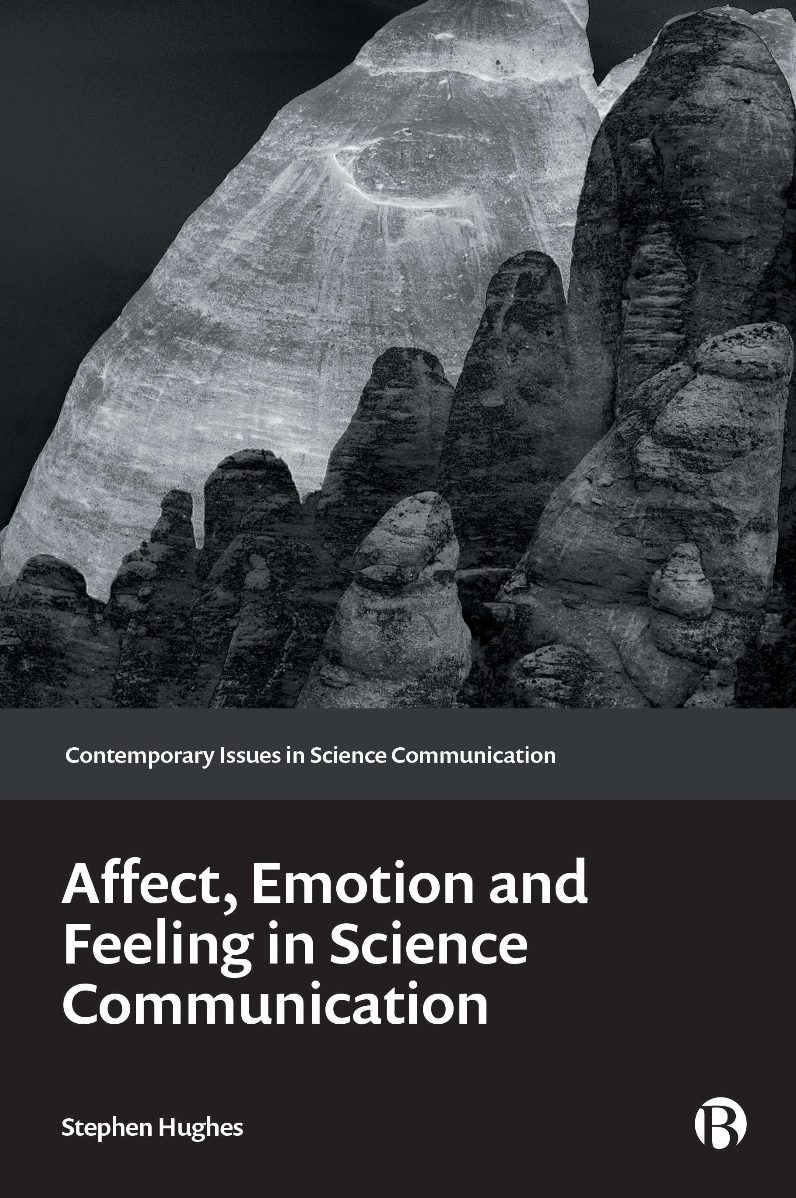
Affect, Emotion and Feeling in Science Communication
Conspiracy theories, vaccine hesitancy, technology hype, and public mistrust are some of the biggest challenges facing science communicators today. This book argues that emotions are the key to understanding these challenges and to unlocking mature forms of science communication and public engagement.
Why doesn’t more information build trust?
The conventional response to public mistrust by scientists, policymakers and communicators is to simply try to supply more information or better communication. When that fails, it is usually explained as a deficit in the public – they didn’t understand, their levels of trust were too low, or they were given bad information (misinformation).
Science communication as a research field has rejected this deficit model for decades. However, its seductive logic persists regardless, largely because the alternatives have never been able to offer a convincing account of what else might be going on. If the problem isn’t a shortage of information, then what is it?
My answer is that science-technology-society relationships are fundamentally human relationships and, like all human relationships, they involve emotions. Our relationships with science and technology are strongly influenced by our dreams and wishes, our anxieties and fears, and the defences we mount against realities that are too uncomfortable to confront.
My work explores the two-way traffic of emotions between scientists, policymakers, communicators and the public, seeking to understand what conditions are required for mutual trust that does not rely on deficits.
What is trust?
Trust is the most talked about thing in science communication. It is also the least understood. Trust is complex – it relates to deeply emotional and intimate human experiences like vulnerability and the desire to be taken care of. When surveys offer single-digit numbers to try to capture trust levels, we lose so much understanding about what is going on when people are trusting, distrustful or ambivalent towards science and technology. When we treat trust as a quantitative level in people that can be either increased or decreased we completely lose sight of the complex psycho-social negotiations that are involved when a person or group comes to trust a vaccine, a chatbot, a government agency, or a tech company. This is why trust interventions so often fail, and why institutions find themselves losing trust as they desperately try to fill what they believe to be a quantitative gap.
Why are conspiracy theories so often about science and technology?
Conspiracy theories are overwhelmingly about technoscience. Vaccines, 5G, geoengineering, smart meters, artificial intelligence are everywhere in conspiracy culture.
They are read in the book as authentic (if deeply flawed and dangerous) attempts at public meaning-making. In contrast to popular interpretations of conspiracy theories that treat them as cognitive errors, the book argues that they can be understood as stories that attempt to make sense of a deeply irrational world.
From this perspective, conspiracy theories provide emotionally satisfying explanations for a technologically advancing world that is frightening and alienating for some. Conspiracies resolve otherwise unmanageable anxieties towards science and technology by defensively splitting the world into the wholly good and the wholly malign. The question then becomes whether these emotional defences are ultimately successful, and what it would take for people to be able to develop more mature responses to anxieties about science and technology.
What do hype and conspiracy have in common?
Hype involves powerful fantasies about how knowledge and technology can allow us to overcome human limitation.
Technoscientific promises defend against existential anxieties about death, bodily limitation, dependence, and uncertainty by investing technology with fantasies of omnipotence and immortality. Those fantasies produce extraordinarily powerful images of what technology can be and do. For people who have no role to play in imagining them, that same omnipotence can be experienced as directed at them rather than wielded by them.
On this reading, conspiracy theory is the affective flipside of hype – the experience of technoscientific promise from the perspective of exclusion and persecution. This suggests something uncomfortable for organisations that circulate and amplify promissory claims about science. Scientists and engineers may be implicated in producing what they then try to fix.
Why does public engagement so often produce nothing?
Engagement exercises frequently generate enthusiastic and positive consensus in the room with no real effect outside it. Deliberative forums are designed to elicit thoughts and ideas from the public that can then be discussed and deliberated. But people do not always know what they think or understand how they feel. Even the most seemingly inclusive forms of participatory communication and engagement can fail to capture how people think and feel about science and technology. To gain deeper access to these beliefs and feelings we need creative experimental approaches to engagement, such as those featured in the book.
What is emotionally mature engagement with science and technology?
The book makes the case for forms of engagement and communication that are capable of confronting and negotiating the complex and conflicting feelings associated with science and technology. Emotionally mature forms of engagement facilitate interactions that make unconscious and uncomfortable thoughts and feelings available for thought, reflection, and deliberation. Emotional maturity operates at the level of human relatedness – intimacy, vulnerability, and mutual interdependence. In the context of trust, it requires that institutions be willing to tolerate being distrusted without feeling the need to go on the defensive.
What the book covers
- Trust. What public trust actually is, once you stop treating it as a quantitative level to be increased.
- Vaccine hesitancy. A psychosocial reading of vaccine refusal, drawing on the cultural and emotional life of an anti-vaccine movement in Ireland.
- Conspiracy theories. Why conspiracy thinking attaches so persistently to technoscience, and what it offers emotionally for the people who engage with it.
- Hype. The fantasy structure of technological promise, and what happens to all that invested feeling when the promise fails to arrive.
- Engagement. Why participatory forms of communication and engagement, such as co-production and citizen science, frequently end up infantilising the “communities” that they seek to serve.
Who it is for
Researchers and students in science communication, science and technology studies, and media and cultural studies; and practitioners in public engagement, responsible innovation, technology governance and research communication who recognise that emotions are central to the breakdown of relationships with society, but do not know how to address it.
Publication details
Affect, Emotion and Feeling in Science Communication is published by Bristol University Press in 2027. Pre-order here.
For review copies, speaking about the book, or interview requests, please get in touch.